+65-98533024





Averages flatten differences. And in the case of Board Evaluation in India, they may obscure the most interesting development.
Across the broader universe of listed companies, Board Evaluation can still appear compliance-driven, internally administered and opaque about what, if anything, changed as a result. But at the leading edge, a different model is becoming visible.
Some Boards are using external facilitation, confidential Director conversations, broader effectiveness criteria, disclosure of findings and year-on-year action tracking. The evaluation is becoming less about whether the Board completed the process and more about whether the process made the Board better.
That is the distinction this article explores.
1. What the earlier evidence showed
In June 2021, NSE-IiAS jointly published a study on Board Evaluation which provided an important historical benchmark.
The study examined 100 companies across the NIFTY 50 and NIFTY Midcap 50 and compared disclosures from 2017 and 2020. It found that Boards largely controlled the evaluation process internally. Only 11 out of 100 companies used external agencies, and in most cases those agencies acted as facilitators or platform providers rather than playing a central role in the evaluation.
Disclosure was improving, but remained muted. Only 11 companies, out of 100, disclosed the outcome of the Board Evaluation. The report noted early signs of movement beyond a check-the-box approach, including indications that director reappointments were beginning to be influenced by evaluation outcomes.
The practitioner commentary in that study was even more revealing. It described many exercises as long, internally run questionnaires that assessed basic measures, produced high scores and generated few actionable recommendations. It argued that good evaluations should examine Board composition, committee leadership, Board dynamics, succession plans, relationships with management and the Board’s ability to contribute to future strategy.
2. What Talentonic’s study of 20 leading companies found
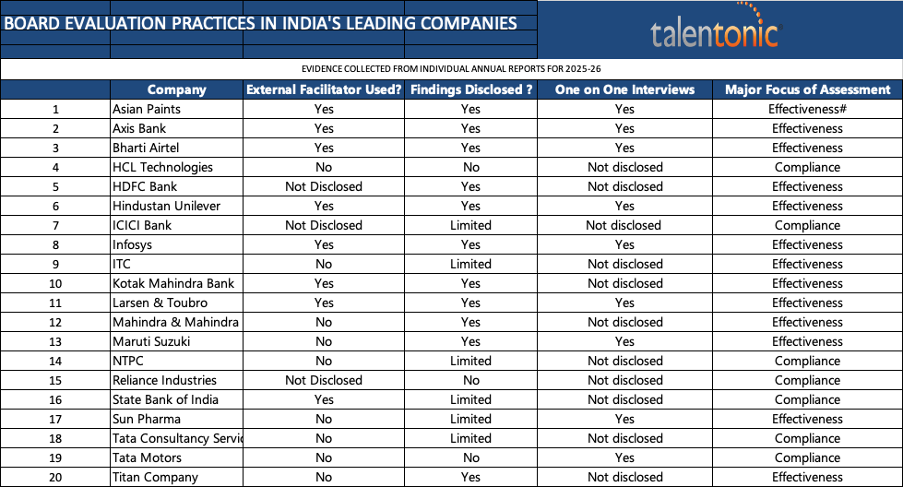
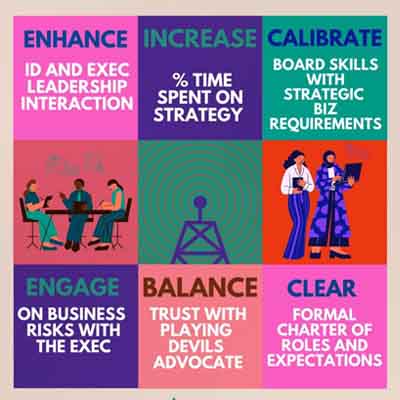
#Where the major focus is effectiveness, the evaluation has gone beyond compliance and process to areas such as succession, talent, board structure, culture of the board , & strategy.
The Talentonic study was deliberately different. We did not attempt to represent the entire population of Indian listed companies. We examined the disclosures of 20 leading companies to understand what was happening at the more developed end of the governance practice.
The findings are encouraging. Eight of the twenty companies explicitly disclosed the use of an external evaluator or facilitator. Eleven disclosed findings of the evaluation to shareholders, while twelve disclosed action tracking of the findings. Nine companies supplemented questionnaires with one on one interviews with all directors and some tabled the findings at the NRC , in a meeting of all independent directors and the full Board.
The 20 companies are not evidence of what is happening to Indian Boards generally. They are evidence of what good practice is beginning to look like.
a) 40% of the Companies are using external facilitators.
b) 55% disclose evaluation findings to shareholders.
c) 45% supplement questionnaires with one-on-one conversations.
d) 65% use evaluation to broaden the dialogue towards Board effectiveness.
e) 60% are now tracking action plans.
Taken together, these practices suggest something more significant than improved compliance. They indicate that, among this group, evaluation is increasingly being used as an instrument of Board effectiveness.
3. So what are the Insights emerging from this sample?
What distinguishes the more mature evaluations in our sample is not any single technique. Taken together, the evidence suggests a progression in the more mature Board Evaluation processes.
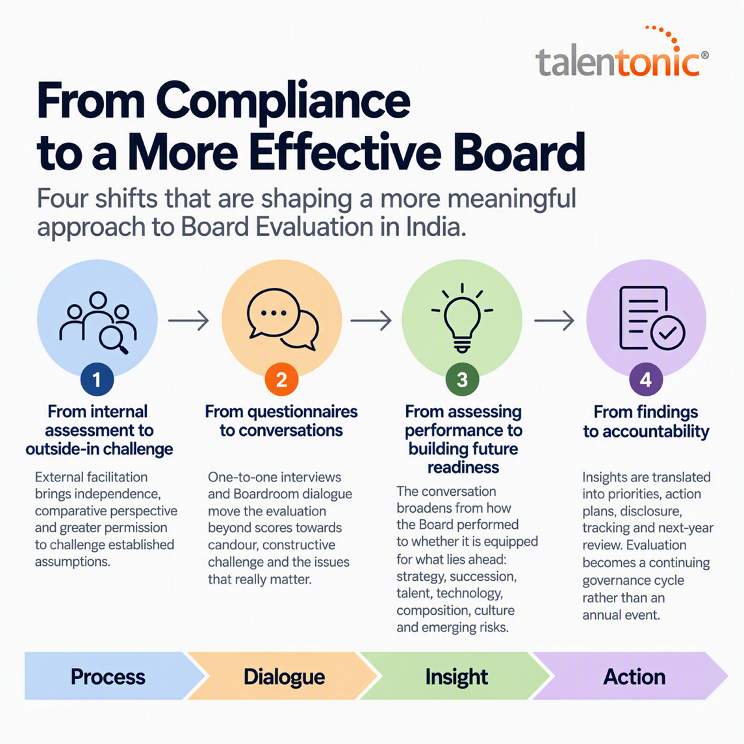
a. From internal assessment to outside-in challenge
More companies are inviting external facilitators into the evaluation process and that in itself is creating an impact.
Infosys, Asian Paints, Bharti Airtel, Axis Bank, Hindustan Unilever, Larsen & Toubro, Kotak Mahindra Bank and State Bank of India, disclosed external facilitators in their disclosures. An external facilitator can introduce an outside-in perspective by probing accepted practices, bringing comparative experience and creating a confidential environment in which directors can raise matters that may be difficult to express through an internally run process.
They encourage candour, use meaningful criteria, identify real issues which lead to action.
External facilitation is an enabler rather than the defining test.
b. From questionnaires to conversations
More progress is created by the dialogue inside the Boardroom than by the pressure of regulation itself. Regulation creates the occasion. Dialogue creates the value.
The NSE-IiAS study described many Indian Board reviews as questionnaire-driven exercises which often generated high scores but relatively few actionable insights. Yet the stronger examples in our review suggest that the process is evolving towards meaningful Boardroom dialogue beyond the structured process. Nine of the twenty Companies (45%) are using one on one director interviews as a way of generating a meaningful dialogue on “things that matter” and converging this dialogue into themes for a wider NRC/Board discussion.
Bharti Airtel , Tata Motors, Asian Paints, Larsen & Toubro , Sun Pharma & Maruti Suzuki supplemented formal assessment with follow-up conversations combining individual director perspectives into actionable themes and future oriented discussions.
The emphasis moves away from generating scores and towards surfacing perspectives. The value of these conversations lies in the differing perspectives they surface: Directors may see the Board one way, Executive Directors and management another, while the Chair may bring yet another view of how effectively the Board operates. Bringing these perspectives together allows the evaluation to move beyond individual responses and reveal patterns, gaps and issues that a questionnaire alone may not expose.
c. From assessing performance to building future readiness
The best evaluations also create space for weak signals. This may be one of the most valuable contributions to future Board readiness. In Talentonic's experience, facilitated conversations can surface what might be called “green shoots” or “minority suggestions”. Concerns, opportunities or emerging risks that do not yet command consensus, but may prove important. A Board Evaluation can provide a legitimate forum for bringing these signals into the room even before they become obvious.
What does this Board need to see, discuss or become next?
At Asian Paints, the evaluation led to further attention on succession for the Board, the Managing Director and Chairperson.
At Bharti Airtel, the Board reviewed prior-year recommendations relating to leadership succession and continued its focus on Board succession, composition and the skills matrix..
HDFC Bank connected prior evaluation priorities to continuing Board attention on generative artificial intelligence and cybersecurity.
Sun Pharma connected prior evaluation priorities to continuing Board attention on generative artificial intelligence and cybersecurity.
Sun Pharma incorporated a mid-year review of implementation, turning the evaluation into an ongoing improvement process rather than an annual event.
ITC , though internally run, is a strong example. They connect Board performance with strategy, stakeholder value and sustainability.
This maturation matters because Board effectiveness cannot be understood through scores alone. Understanding this requires conversation and judgement.
The 2025 ISB study, The Board's Looking Glass, provides a useful complementary perspective. Based on responses from over 200 directors serving on BSE 500 company boards, it identifies gaps between the formal architecture of governance and what happens in the Boardroom. In particular, it points to the need to move from process to behaviour, from reviewing strategy to influencing it, and from being “reviewers of the known” to “explorers of the unknown”.
The study does not establish whether Board Evaluation itself has improved effectiveness. But it provides a useful picture of the behaviours and capabilities that a serious evaluation should increasingly examine.
d. From findings to accountability
The stronger companies do not stop at saying that the evaluation was satisfactory. They disclose at least some of what was learned and what they intend to do next.
At Asian Paints,. Its disclosure identified the need to strengthen the tracking of important matters, particularly succession planning, and to formalise alignment around strategy and Board priorities. The Board also reviewed progress against recommendations from the previous year.
At HDFC Bank, the disclosure identified opportunities relating to Board composition, continuous learning, emerging risks and customer experience.
At Sun Pharma, action points were tracked through the NRC and reported to the Board, with implementation reviewed during the year.
Disclosure creates accountability. A company that publicly identifies a focus area creates an implicit expectation that it will report progress later. The evaluation starts to become part of a continuing governance cycle:
4. Have the SEBI regulations served their purpose?
The most defensible answer is: partly, and increasingly at the leading edge. Regulation created the architecture. It established Board Evaluation as an expectation and gave the NRC, Independent Directors and Boards defined responsibilities.
But regulation cannot mandate candour.
It can require a process; it cannot require an honest conversation. The evidence from our sample suggests that progress occurs when Boards use the regulatory occasion to create a genuine dialogue about purpose, performance and future readiness. At the leading edge, a deeper model is becoming visible: external challenge, qualitative conversations, broader assessment criteria, disclosure of findings, action plans and year-on-year review. Ultimately, perhaps every Board Evaluation should answer one question:
“Is this company better governed because this particular group of directors is sitting around this table?”
In uncertain times, this may be the most valuable questions for a Board to ask itself.