+65-98533024






A. The Succession Lens.
Leadership continuity is emerging as a material governance risk for Indian listed companies. Aggregate CEO/MD churn remains around 5-6%, but turnover among major companies and critical KMP positions is bringing succession preparedness into sharper focus. This raises an important question for NRCs: not whether executives will leave, but whether the organisation has credible, board-supervised succession ready when they do.
Recent leadership exits in India have demonstrated that investors increasingly view succession and leadership continuity as material governance issues. Market reactions suggest that investors are not merely responding to the departure of an individual executive, but to the uncertainty created around future leadership, strategic execution and board oversight.
1. In March 2026, HDFC Bank's shares fell nearly 9% intraday following the sudden resignation of its part-time Chairman and Independent Director, Atanu Chakraborty. The stock subsequently declined by approximately 12% over the following three trading sessions, highlighting investor sensitivity to perceived governance uncertainty.
2. In August 2026, shares of several Tata Group companies declined following N.Chandrasekaran's announcement that he would not seek a further term as Chairman of Tata Sons, notwithstanding his continuation in office until February3. 2027. TCS fell by more than 3.7%, while several other Tata companies also traded lower, reflecting investor concern regarding succession and strategic continuity and future capital-allocation priorities.
3. Similarly, Godrej Consumer Products' shares fell by around 10% following the resignation of MD & CEO Sudhir Sitapati despite the company simultaneously identifying a successor, indicating that investors remain sensitive to leadership transition risk even where succession arrangements are announced.
Taken together, these examples suggest that the market increasingly treats senior leadership departures as a test of the effectiveness of the board's succession-planning processes, with particular attention to the role of the Nomination and Remuneration Committee (NRC).
Succession preparedness is no longer viewed merely as a procedural governance requirement; increasingly, it is regarded by investors as a factor with direct implications on shareholder value and long-term corporate resilience.
Having a successor is important, but investors may still reassess the company's prospects when a leader whom they associate closely with strategy and performance leaves
B. The Role of the NRC.
These episodes should not, by themselves, be characterised as evidence of NRC performance. Share prices are influenced by many factors, and a market decline following an announcement does not establish that the Board's succession processes were inadequate. What the reactions do demonstrate is that leadership continuity has become financially visible to shareholders.
This makes succession a particularly useful lens through which to examine the broader role of the NRC.
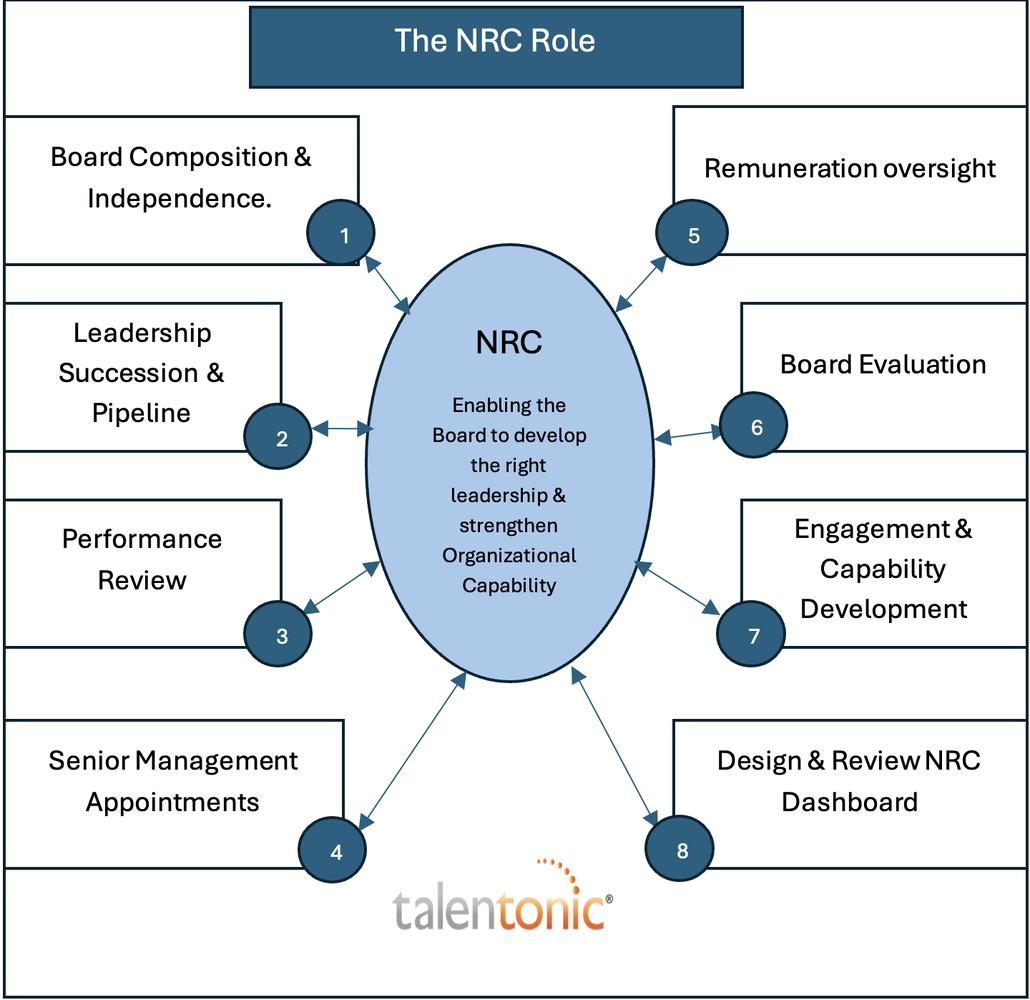
A strong succession process is the outcome of many of the NRC's other responsibilities working together: rigorous performance evaluation, identification of capabilities required for the future, assessment and development of leadership talent, maintenance of Board independence, appropriate remuneration and retention structures, and continuous evaluation of the Board and senior management. These responsibilities are closely aligned with the NRC functions prescribed under the regulatory framework. So no great surprise here. !
The more important governance question, therefore, is not simply "Does the company have a successor?" It is "Has the NRC created an institutional process that continually produces, evaluates, retains and refreshes the capabilities which the organisation requires?" Succession is only one component of this wider mandate, but it is perhaps its most publicly observable stress test. Succession attracts greater stakeholder attention because failure becomes visible quickly and can be reflected almost immediately in investor confidence and market value.
However, this broader role of the NRC does create some tension. The ability to build effective leadership teams, and strengthen organisational capability has always been regarded as good management practice. A decade ago, companies that excelled in these areas were viewed as differentiated. Today, the operating environment has changed. Rapid disruption in the business environment and heightened investor scrutiny have altered the nature of corporate risk itself. Issues relating to capability and organisational resilience have moved from being good practices, at the periphery of the Board agenda, to an understanding that this is a strategic risk. Not something which can be reported half yearly. Not easy to measure using known methods, but slowly becoming critical to growth.
This creates a natural tension. Management often sees these “NRC issues” as part of its day-to-day responsibilities—and, to some extent, they are right. As a result, management may resist NRC oversight of areas such as recruitment, training and employee motivation. At the same time, some NRCs define their role too narrowly, focusing only on appointments, pay proposals and governance procedures instead of overseeing leadership and organisational capability risks. Shareholders expect Boards to oversee the main risks that could harm the company’s long-term performance. In the past, these risks were mainly linked to financial controls and compliance. Today, the organisation’s ability to attract, develop and retain the right capabilities is also a major risk.
The most effective NRCs will not be those that merely approve appointments and remuneration proposals, but those that help the Board understand and oversee capability risk with the same discipline applied to financial, strategic and operational risks. Succession planning remains the most visible test of this responsibility, but it is only one manifestation of a much broader governance mandate.
The Indian Boardroom is a diversified group with different practices and definitions of effectiveness. There is a lot to be done. The Chair of an NRC we work with spoke about the battle they had to fight to get the NRC time increased from 30 minutes to 60 minutes ; to get the Management to agree to giving them a choice for KMP selection rather than presenting them with a fait-accompali. !
This is unchartered territory and slow progress is being made as managements recognise the value of dealing with the capability risk, and Independent directors align better at framing that risk. As this dialogue matures progress is being made.
What motivates the ‘Board watchers’ is that while the average performance is still a bit low, the direction appears clear and there are best practices to follow.
C. NRC Best Practices.
1. Move from succession planning to leadership-pipeline oversight
Many NRCs spend disproportionate time discussing the CEO successor. Leading NRCs instead look at the entire leadership ecosystem. How resilient would the organisation be to meet the complex challenges and opportunities over the next 5 years.
2. Treat organisational capability as a Board issue
Traditionally, NRCs reviewed people. Leading NRCs review capabilities. NRCs are moving from “talent oversight” to “capability stewardship”. “What capabilities must this organisation possess to win five years from now, and do we currently have them?"
3. Connect remuneration to long-term value creation
Many remuneration discussions remain benchmark-oriented. The objective is not merely "competitive pay" but "strategic pay." . What behaviours are we rewarding. ? Is it linked to long term value creation. ? Is there alignment among stakeholders. Compensation becomes a governance tool rather than an HR process.
4. Make Board effectiveness a continuous process
Many Board evaluations become annual compliance exercises. Focus on Board composition, quality of debate, contribution of independent directors. Time allocation to “things that are beginning to matter
5. Protect and strengthen Board independence
This is frequently under-appreciated. Cognitive diversity. Capability to challenge and disagree. Independence of directors.
6. Develop a leadership and culture dashboard
The strongest NRCs receive regular capability reporting in much the same way Audit Committees receive financial reporting. Successor readiness. Internal promotion ratios. Employee engagement. Critical hiring gaps. Development challenges. This facilitates early identification of organisational risks before they become governance events.
As a friend who is an Audit & NRC Chair points out. "Noses in and fingers out. Stay informed and ask insightful questions (“noses in”) without micromanaging or interfering in daily executive operations (“fingers out”).”
At Talentonic HR Solutions Private Limited, we are delighted to be part of this process and to have ignited this debate in various Boards . Thankful for being inducted as knowledge partners for Board Stewardship or exchange of ideas and insights.